Wednesday, September 26, 2012

Chocolate & Onions & Grapes, Oh My!

Not the ingredients in the latest weird recipe but rather some common pet poisons.

The list of common foods that are toxic to our family pets may surprise you. I've been practicing veterinary medicine so long that I sometimes forget new generations of pet owners are starting over at the beginning.

Without further ado, some don'ts when it comes to sharing table foods:

Chocolate

PLEASE DON'T SHARE
(Courtesy of The behavior company)
Almost all pet owners are aware of cocoa and chocolate's toxicity. In general, the darker and more bitter the more dangerous. One chocolate chip cookie or a Hershey's kiss are unlikely to be a problem for a ninety pound labrador, but an ounce of baker's chocolate would very likely send a chihuahua to the nearest veterinary hospital.  The problem ingredient is theobromine which causes the usual array of gastrointestinal symptoms, vomiting and diarrhea being the common signs. Higher doses however can lead to hyperactivity, changes in heart rhythm, seizures and death.


Macadamia Nuts
I had a pup in just last week who had helped himself to a significant serving of these smooth round little morsels. He was intermittently vomiting primarily whole nuts but happily eating most of his meals. I was a little concerned that the unchewed nuts would be a good fit for his small intestine and a blockage was imminent. Fortunately his malaise was limited to a few days of belly aching. It could have been worse, symptoms of macadamia nut poisoning include weakness, vomiting, joint pain, fever and depression.


(Courtesy of dogsite.do.am)
Grapes & Raisins
Ingestion of grapes and raisins can lead to the sudden onset of kidney failure. The toxic dose seems variable by weight and individual. So far, there's no way to know which dogs will develop kidney failure from a few grapes or several. Symptoms include vomiting, increased thirst and excessive to reduced urination as the injury progresses. Quick veterinary care is necessary if affected animals are to survive.

Onions
Onions and related garlic and leeks cause the hemoglobin in canine and feline red blood cells to precipitate or "clump," rendering those cells unable to carry oxygen properly and marking them for destruction by the body's immune system. This quickly leads to anemia, evidenced by pale gums, increased heart and respiratory rates, weakness, poor appetite and vomiting. How much is toxic? A thirty pound dog eating 1/4 cup of yummy sauteed onions and garlic would be in trouble.

DOUGHN'T!
(Courtesy of petswebmd.com)
Raw bread dough
If a pet eats raw dough made with yeast his body heat causes the dough to rise and the fermentation also produces alcohol. Signs can include bloating, non-productive retching, lethargy, respiratory depression, weakness and collapse.


Xylitol
This alcohol sugar is a sweetening agent in many candies, gums, baked goods and human toothpaste. It can cause a dangerous drop in blood sugar and liver damage, both of which can be life-threatening. Signs in dogs can include vomiting, weakness, difficulty walking and seizures.

If you really need to share a people snack with your pup or kitten, try raw carrots, green beans, apple or melon, which have the added advantage of being low calorie!


Thursday, September 20, 2012

Of Llamas and Cats

Few newborns are more endearing than kittens and crias.


(Courtesy of wishlistz.blogspot.com) 

In the case of kittens, they're the perfect size for snuggling and endlessly entertaining when they reach the pounce and play stage. One kitten is great fun, two or more is a party of climbing, hide and seek and wrestling. Toes under blankets need beware when a kitten's on the prowl.


(Courtesy of animaladay.blogspot.com)

Crias, the young of alpacas and llamas, are also endearing. Gaining their legs within minutes of birth, their upright posture and the way they seem to march forward always reminds me of toy soldiers. How could you not want to cuddle something warm and woolly and curious that looks like a stuffed animal come to life?


AND THAT'S THE PROBLEM!

Well, part of it anyway. Kittens and crias are such adorable youngsters that when they happen to be orphaned human caretakers tend to step in to save them, and then some. It's the 'and then some' that gets us into trouble.

In the case of kittens, many rescuers bottle feed and raise them to adulthood, completely unaware of the potential for danger. I've lost count of the number of adult cats I've seen in the exam room who were screaming, spitting, hissing terrors whose owners, sporting well-scratched arms and legs, have said something like, "I don't understand it. I raised her from 3 days old..." And now the very pet they've nursed and loved attacks them at home without noticeable warning and looks at me with something akin to murderous intent.

Similarly, hand-reared llamas can become so aggressive to people that there's a term for it, "Berzerk Male Syndrome". Despite the name, bottle-fed females can also develop aggression toward humans but usually limit their acting out to spitting and being generally difficult to handle. Berzerk males on the other hand are out to kill.

What's going on with these rescue cases?

Current thought is that the young animals imprint on their human caretakers, never developing a respect for human boundaries. It's not so much because of the bottle-feeding as it is the cuddling and handling that often accompanies it and isolation from others of the same species.

Male llamas by nature are territorial and aggressive in their defense of space and resources. If they perceive humans as "equals" because they've been hand-raised, when puberty hits people become the competition. Humans lose every time.

Although I'm not aware of any formal studies regarding hand-raised orphan kittens I've seen the results often enough to suspect something similar occurs in their little feline brains. Many cats are significantly less than delighted to be to be interrupted in their napping, placed in a carrier and driven a few miles to a strange-smelling veterinary clinic. Some will hide, some grumble a bit and the occasional patient complains loudly at a temperature taking or other invasion of personal space. In most cases there's an obvious reason for the fearfulness or complaint and I'm accustomed to working quickly and quietly to make their visit as stress-free as possible. And then there are the special cases who don't need any provocation to attack at home or in the exam room. Often when I ask, they've been hand raised alone by a doting owner, never learning to interact with other cats or other people properly.

The Solution
Ideally we wouldn't have orphans to raise, but barring the impossible there are some steps to take.

Alpaca and llama breeders are, (or should be), aware of the risks involved and take steps to raise their orphans with other llamas and discourage any playful nibbling, bumping, rearing and in-your-face behavior which seems cute in a little one but could be a prelude to trouble.

Orphaned kittens can be a little more challenging to properly socialize but every attempt should be made to find another cat to "mother" the baby, even if it  means bottle-feeding but placing the kitten elsewhere for his own good. If another cat nursing kittens can't be found, neutered adult males often make great uncles, tolerating a kitten's playfulness while teaching him his manners. And you can always call your veterinarian for ideas, most of us have a soft spot for small bundles of fur...


Friday, August 31, 2012

So long, farewell

(Courtesy of buzzle.com)
"Some people come into our lives and quickly go. Some stay for a while,  leave footprints on our hearts, and we are never, ever the same."
– Flavia Weedn 
 
 
I recently said a lot good-byes. After more than two decades in a mixed small animal and equine practice and with a milestone birthday rapidly approaching, it's time for something different. However, despite looking forward to something new, I'm also losing regular contact with some very dear co-workers, friends, clients, and critters.

The good news is that my clients and patients are in good hands, the practice seems to be running smoothly and I have every confidence this will continue.

As I said a few personal good-byes, I was struck by the tears and depth of emotion expressed. I'm so very grateful to have met and worked with the many wonderful people who trusted me with their furry family members.

Great memories and lessons learned.

From Cocoa's mom, a fiercely independent woman in her 80's who only recently gave up cross-country RV travel, and then only to appease her doctors and adult children: Don't give up despite adversity and keep good people close. Stubborn isn't a bad thing in the pursuit of health and happiness. From Cocoa herself: Devotion beyond words.

From Bella, Iz and Gracie's parents: You don't get a second chance to make a good first impression. And little things matter as much as big things. Considering the fact that Bella tops 100 pounds and Gracie is little more than a handful of dog this goes for the entire family. Izabo, the middle child, is just lovable in a slightly goofy Irish Setter sort of way and further illustrates that you have to treat the individual and not the lab work which might say everything's normal. I also really appreciate that each of them knows how to walk nicely on a leash and step onto the scale and wait without wrestling or yelling, proof that all sizes of canines can have manners. I'm going to miss this motley crew. Canine relative Morton Keith, a corgi of rare distinction, may be the most pampered 40 pound lap dog I've ever met. We should all be so lucky.

From Felix and Eight Ball and company: Sometimes the usual treatment works for an unusual ailment, for a little while. After that you need to look more closely because sometimes hoof beats mean zebras, not horses. Never underestimate how much time and expense a devoted owner is willing to invest in her beloved felines! And thank goodness for veterinary specialists whose advanced training, specialized diagnostic equipment and expertise improve the quality and quantity of life for so many of our animal family members.
 
From Brenna and her mom: Go for it!

From Two's humans: Some people will give the shirt off their backs...to a newborn foal in a cold barn.
 
From Shiloh and the subsequent crew, schnauzers are people too, even if they do have ear-splitting yelps as puppies.

Baron and his mom: You may be in exactly the right place at precisely the right time even when you've never been there before and you're an hour early. I was reminded of an interesting extension of the concept of Mitzvah, a random act of kindness, which is that being vulnerable enough to allow someone the opportunity to help you is itself an act of kindness. Being real matters, and it's all too rare in our rush to do...what?
 
There are many, many more individuals and families I've been fortunate to know. Some have been mentioned in previous blogs and others will appear in future posts. I'm immensely grateful to all of them for the experience gained, the humor shared, the kindnesses shown, and especially the trust given. It's no small thing to place the life of someone you love in another's hands, and I've been honored.
 
"Be well, do good work, and keep in touch" – Garrison Keillor.

Sunday, August 19, 2012

A Tale of Two Shepherds

I recently had two appointments with German Shepherds in one afternoon. They could hardly have been more different experiences.

The first dog had an eye irritation which turned out to be a mild conjunctivitis, an inflammation of the delicate tissue lining the eyelid. He cowered behind his owner and strained at the leash as soon as he entered the building then quivered and trembled and fretted for the entire conversation involving his history. Once on the exam table, he repeatedly jerked away at the slightest attempt at a closer look. His body language was screaming, "fear-biter," which is a term veterinarians and others in the dog world use to describe those dogs so afraid of something new that they tend to bite first and ask questions later. Dogs like this aren't necessarily aggressive but they can be extremely dangerous to handle because they panic.

(Courtesy of petmd.com)


The classic fear-biting dog has a cowering stance, tucked tail, ears back and a growl or snarl on his face. He's most dangerous when cornered or confined and may bark uncontrollably if approached. Owners frequently offer various explanations:
"He was abused..." (Never by them but in some unknown past.)
"He doesn't like men/women/short people/lab coats..." (Air?)
"He's never done this before." (Unless you count every time someone new visits or he goes out in public.)

The second Shepherd that afternoon was an entirely different story. He trotted in on a leash, looked around with interest, came forward to greet me with a tail wag and waited fairly calmly for his exam, routine vaccinations, deworming and a discussion of his next visit.

The first fearful, bundle-of-nerves dog was an 80 pound 2-year-old adult. The second was a fifteen pound 10-week-old pup off to a good start. These individuals illustrate the importance of early socialization in helping our canine companions along the road to good citizenship. Early, gentle but no-nonsense handling and consistent obedience training are crucial to safe canine-human interactions.

Puppies enter a particularly critical stage at about 12 weeks of age when it's especially important to expose them to good experiences with the many different nouns, (people, places, and things), they are likely to encounter as adults. Older dogs with fearful tendencies aren't lost causes. A consistent routine and basic obedience training will often give them the confidence to count on their owners for guidance.

Many times the fear-biter is anxious because he doesn't know what to expect or how to behave in a given situation. I often recommend  an owner start the fearful dog rehab process by perfecting  a good sit, down, stay command in a non-stressful home setting. It also helps to avoid inadvertently reinforcing fearful behavior by reassuring an overly anxious pet in a nice voice, "It's o.k.," which essentially tells him his over-the-top behavior is appropriate. Rather than comforting, giving a calm, "No. Sit." followed by a pat and "Good," once he's sitting is often enough to quell the anxiety and allow the pet to relax and have a good experience in a new place. It can take some time and patience, but your veterinarian and visitors will thank you. (And if your pet ever needs hospitalization and treatment it will actually be possible to help him...)


Thursday, August 9, 2012

Tick Talk & Timely Tips

'Tis the season for all manner of creepy crawly critters in and on our pets and sometimes on us. A quick line up of the usual suspects and some tips for keeping them at bay:

TICKS, FLEAS & MOSQUITOES
Technically members of the arachnid class, (like spiders), ticks have 8 legs and multiple life stages wishing for a blood meal on a passing mammal or bird. Their habit of feeding, maturing, feeding, molting, and feeding again makes them excellent disease vectors.

Adult tick activity is at a peak in fall and early winter. Coincidentally, adult ticks are most likely to transmit disease. Protect yourself and your pets while out and about in the woods this season.

Here's a good picture to help differentiate between deer ticks and dog ticks.
The pencil gives a good sense of scale and both deer ticks and dog ticks are in the same shot
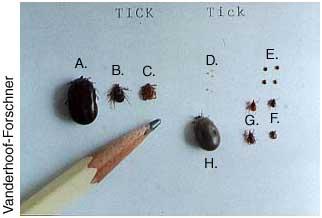

Brown Dog Ticks               Deer Ticks                          
A. Engorged Female            D. Larvae
B. Female                             E. Nymphs
C. Male                                 F. Males
                                             G. Females
                                             H. Engorged Female


Fleas are another blood thirsty pest, many detailed technical resources exist. Suffice to say one female flea can produce approximately three gazillion baby fleas, all of them hungry and none too discriminating about who they feast on. Rodent fleas were a significant contributing factor in the spread of bubonic plague in 14th century Europe, killing an estimated 25 million people.

Mosquitoes, often referred to as the state bird of Michigan, are a plague unto themselves for people and pets.


In addition to a significant "ick" factor, ticks, fleas and mosquitoes are responsible for transmitting a variety of diseases and blood parasites to a variety of animals, humans included. A few examples are listed below.

Diseases Transmitted by Ticks
Babesiosis
Ehrlichiosis
Lyme Disease
Anaplasmosis
Rocky Mountain Spotted Fever

Diseases Transmitted by Fleas
Tape worms
Mycoplasma
Bobcat fever, (Cytauxzoon felis)
Bubonic plague, (Yersinia pestis)

Diseases Transmitted by Mosquitoes
Heartworm
West Nile Virus
Eastern &Western Encephalitis

CUTEREBRA
This is an affliction of rabbits, squirrels, kittens and young cats with outdoor exposure. The Cuterebra fly eggs hatch into larvae which enter the body through the mouth, nose, or a wound then migrate under the skin. The larva creates a breathing hole in the skin and grows up to an inch in length and 1/2 inch in diameter before burrowing out to pupate into an adult fly.


LICE
Lice are species-specific, meaning animals don't share their lice with people and human lice do not live on pets. You can be sure your school age youngster did not catch lice from sleeping with the family pet but rather from close contact with another infested child.

CHEYLETIELLA, OTODECTES, DEMODEX & SARCOPTES MITES
Another arachnid group, these mites are the cause of "walking dandruff, ear mites and two types of mange. Close contact with another infested animal is necessary for transmission. Sarcoptic mange mites can infest people, causing a rash and intense itching.

INTESTINAL PARASITES
Cats and dogs are susceptible to a variety of intestinal worms. The common names, (hook, round, tape and whip), refer to the shape or physical characteristic of the offensive party. All are transmitted by ingesting contaminated feces or intermediate hosts like fleas, and some may be spread from dam to newborn via the placenta or milk. Additionally, hookworm larvae can penetrate human skin and migrate around the body. Intestinal parasites are a significant cause of diarrhea, anemia, weight loss and poor growth in our animal friends. An estimated 90% of equine colic cases are caused by intestinal worms.

Now that you're suspiciously itchy and just plain suspicious of your furry companions, some tips for preventing and treating your pet's "pets."


The good news is, disease from every one of the above parasites is preventable.

First, pay attention to your pet's skin, hair coat and general condition. If you know what's normal you'll be better able to recognize a problem. Regular grooming feels good to your pet and allows you to find fleas and ticks quickly before a full blown infestation or disease transmission can occur.

Second, regular veterinary exams, heartworm and intestinal parasite testing are an important part of wellness care which can extend both the quality and quantity of your pet's life. This is true for indoor only, indoor mostly, and indoor never pets.

Third, intelligent use of preventatives for fleas, ticks and heartworm disease can virtually eliminate these afflictions. Please consult your veterinarian for the safest and most effective products for use in your area. Many over-the-counter products for use on pets have insecticide concentrations 15 to 20 times those used in premise and kennel sprays. Some OTC flea and tick products have resulted in adverse reactions ranging from skin irritation to severe vomiting, diarrhea, coma, seizures and death.

Fourth, limit your pet's exposure to pests. For example, indoor cats don't get cuterebra larvae. Limiting exposure to wildlife areas or dog parks along with regular testing and treatment as needed can prevent most intestinal infestations.

If the thought of hugging your furry family member now gives you pause, maybe there's something you can do to fix it...


Sunday, August 5, 2012

Dog Days Of August II


In my last post I wrote about a young beagle caught in a trap and what seemed to be a happy ending. Now for the rest of her story.

The excitement of her rescue faded in the ensuing weeks, and after a few retellings of her story, (including a cautionary note about traps), routine settled in again. As much routine as possible anyway when a late night call for a stray hit by a car didn't especially raise my eyebrows. The lady who called was neither an established client nor a pet owner but rather a Good Samaritan who found an injured dog in the dark on the expressway and wanted to bring her in for care. Remarkably, despite multiple pelvic fractures and some road rash she was fairly stable when I examined her. I administered supportive fluids, antibiotics and a good dose of pain medication. I gently cleaned her wounds, protectively bandaged what I could, and bedded the little beagle down for the few hours until morning.
(Courtesy of winnepeg.olx.ca)

 
It was actually my assistant who, looking askance at the stray beagle, said she looked familiar. (I must confess, after 20-odd years of practice, to a certain blurring of tri-colored beagles. If you've seen one...)

(Courtesy of diamondkennel09)


"No way," we decided.
It couldn't possibly be the one we'd rescued and placed in the care of an established doggie person. Still, she did have a certain air of familiarity and a bit of an indentation behind her ears and so we called our foster home and inquired about the beagle we'd placed.

Sounding a bit distressed, the gentleman said she was a diligent digger and after several foiled attempts had managed to escape his fenced yard several days after he took her home, in the vicinity of the expressway upon which our current inmate had been hit.  By this time, the lady who had rescued her had decided she'd like to adopt and nurse the broken little dog back to health and so she did. In the ensuing several years our twice-rescued stray healed, sailed through a couple of surgeries and despite an uneven gait and some issues with constipation has been quite healthy. Aptly or not, her name now is "Lucky."
(Courtesy of The Reticule)


Wednesday, August 1, 2012

Dog Days of August


(Courtesy of Tom Warner)


It was the kind of 100% humidity August afternoon in Michigan  that made you wish it would rain just so you'd have an excuse for being drenched.  A sweltering, heavy, breeze less day that made even the thought of being outdoors, much less any exertion, exhausting. I was thankful to be returning from lunch to the relative comfort of an air conditioned office when I heard the ear-splitting cry of an animal in distress.

The clinic is rural, with a big circular driveway in front and about a 30-50 foot swath of mowed lawn on the sides and back. Immediately beyond this bit of tended green is taller grass and brush and the occasional tree which abuts, on one side, a large vegetable garden in the summer. On this late summer day the garden was well on its way to harvest, and I suspect it was an attempt to protect the produce which led to one of the most horrific scenes I've ever happened upon.

Dropping my keys and purse on the porch I followed the screaming around the corner of the clinic and into the brush to find a beagle with her head down a groundhog hole. I thought perhaps she'd tangled with the occupant but found it odd that she was crying so but not trying to back pedal. It's for good reason beagles are known for their keenness of nose rather than mind, but even a beagle should have elected retreat at that point. Except she couldn't retreat, because rather than a groundhog on her snout, the steel jaws of an illegally placed Conibear trap had closed on her head.

By that time my receptionist was also back from lunch. Neither of us was familiar with the release mechanism, (see above link), but we had a plan to save the little tri-colored stray. I grabbed emergency supplies and anesthetic while she started phoning for help. She knew the neighbor with the garden and didn't spare his feelings telling him what had happened and that if he or his son had anything to do with it to get over immediately. (I should note here that she doesn't share my aversion to profanity-laced tirades.) Within minutes we had pain medications and a light sedative on board and her head free. Amazingly, the jaws had closed at such an angle on her skull that her airway and other vital structures were spared. The other big concerns were dehydration and hyperthermia. With her head down a hole in a sunny field on such a hot day she was unable to cool herself by panting and her panicked struggling had only added to her distress.

(Courtesy of VanEton Galleries)
Hoping for the best, I carried her into the clinic and began supportive treatment. I placed an intravenous catheter, started fluids and steroids and watched her...getting better by the minute.

      
Not only had she survived wandering off from wherever she came from, which very likely included a jaunt across a busy Michigan Highway, and a steel trap closing on her head, but an hour after finding her, she was lapping a small drink of water and wagging her tail. We suspected she was a refugee from a kennel with too many dogs and not enough food. With little discussion, we implemented the veterinary version of don't ask, don't tell and, with a healthy dollop of serendipity, had her placed in a foster home by 4:30.

Except she didn't stay there either...

(To be continued.)