Sunday, August 19, 2012

A Tale of Two Shepherds

I recently had two appointments with German Shepherds in one afternoon. They could hardly have been more different experiences.

The first dog had an eye irritation which turned out to be a mild conjunctivitis, an inflammation of the delicate tissue lining the eyelid. He cowered behind his owner and strained at the leash as soon as he entered the building then quivered and trembled and fretted for the entire conversation involving his history. Once on the exam table, he repeatedly jerked away at the slightest attempt at a closer look. His body language was screaming, "fear-biter," which is a term veterinarians and others in the dog world use to describe those dogs so afraid of something new that they tend to bite first and ask questions later. Dogs like this aren't necessarily aggressive but they can be extremely dangerous to handle because they panic.

(Courtesy of petmd.com)


The classic fear-biting dog has a cowering stance, tucked tail, ears back and a growl or snarl on his face. He's most dangerous when cornered or confined and may bark uncontrollably if approached. Owners frequently offer various explanations:
"He was abused..." (Never by them but in some unknown past.)
"He doesn't like men/women/short people/lab coats..." (Air?)
"He's never done this before." (Unless you count every time someone new visits or he goes out in public.)

The second Shepherd that afternoon was an entirely different story. He trotted in on a leash, looked around with interest, came forward to greet me with a tail wag and waited fairly calmly for his exam, routine vaccinations, deworming and a discussion of his next visit.

The first fearful, bundle-of-nerves dog was an 80 pound 2-year-old adult. The second was a fifteen pound 10-week-old pup off to a good start. These individuals illustrate the importance of early socialization in helping our canine companions along the road to good citizenship. Early, gentle but no-nonsense handling and consistent obedience training are crucial to safe canine-human interactions.

Puppies enter a particularly critical stage at about 12 weeks of age when it's especially important to expose them to good experiences with the many different nouns, (people, places, and things), they are likely to encounter as adults. Older dogs with fearful tendencies aren't lost causes. A consistent routine and basic obedience training will often give them the confidence to count on their owners for guidance.

Many times the fear-biter is anxious because he doesn't know what to expect or how to behave in a given situation. I often recommend  an owner start the fearful dog rehab process by perfecting  a good sit, down, stay command in a non-stressful home setting. It also helps to avoid inadvertently reinforcing fearful behavior by reassuring an overly anxious pet in a nice voice, "It's o.k.," which essentially tells him his over-the-top behavior is appropriate. Rather than comforting, giving a calm, "No. Sit." followed by a pat and "Good," once he's sitting is often enough to quell the anxiety and allow the pet to relax and have a good experience in a new place. It can take some time and patience, but your veterinarian and visitors will thank you. (And if your pet ever needs hospitalization and treatment it will actually be possible to help him...)


Thursday, August 9, 2012

Tick Talk & Timely Tips

'Tis the season for all manner of creepy crawly critters in and on our pets and sometimes on us. A quick line up of the usual suspects and some tips for keeping them at bay:

TICKS, FLEAS & MOSQUITOES
Technically members of the arachnid class, (like spiders), ticks have 8 legs and multiple life stages wishing for a blood meal on a passing mammal or bird. Their habit of feeding, maturing, feeding, molting, and feeding again makes them excellent disease vectors.

Adult tick activity is at a peak in fall and early winter. Coincidentally, adult ticks are most likely to transmit disease. Protect yourself and your pets while out and about in the woods this season.

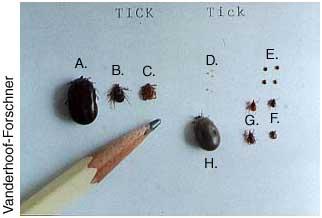
Here's a good picture to help differentiate between deer ticks and dog ticks.
The pencil gives a good sense of scale and both deer ticks and dog ticks are in the same shot


Brown Dog Ticks               Deer Ticks                          
A. Engorged Female            D. Larvae
B. Female                             E. Nymphs
C. Male                                 F. Males
                                             G. Females
                                             H. Engorged Female


Fleas are another blood thirsty pest, many detailed technical resources exist. Suffice to say one female flea can produce approximately three gazillion baby fleas, all of them hungry and none too discriminating about who they feast on. Rodent fleas were a significant contributing factor in the spread of bubonic plague in 14th century Europe, killing an estimated 25 million people.

Mosquitoes, often referred to as the state bird of Michigan, are a plague unto themselves for people and pets.


In addition to a significant "ick" factor, ticks, fleas and mosquitoes are responsible for transmitting a variety of diseases and blood parasites to a variety of animals, humans included. A few examples are listed below.

Diseases Transmitted by Ticks
Babesiosis
Ehrlichiosis
Lyme Disease
Anaplasmosis
Rocky Mountain Spotted Fever

Diseases Transmitted by Fleas
Tape worms
Mycoplasma
Bobcat fever, (Cytauxzoon felis)
Bubonic plague, (Yersinia pestis)

Diseases Transmitted by Mosquitoes
Heartworm
West Nile Virus
Eastern &Western Encephalitis

CUTEREBRA
This is an affliction of rabbits, squirrels, kittens and young cats with outdoor exposure. The Cuterebra fly eggs hatch into larvae which enter the body through the mouth, nose, or a wound then migrate under the skin. The larva creates a breathing hole in the skin and grows up to an inch in length and 1/2 inch in diameter before burrowing out to pupate into an adult fly.


LICE
Lice are species-specific, meaning animals don't share their lice with people and human lice do not live on pets. You can be sure your school age youngster did not catch lice from sleeping with the family pet but rather from close contact with another infested child.

CHEYLETIELLA, OTODECTES, DEMODEX & SARCOPTES MITES
Another arachnid group, these mites are the cause of "walking dandruff, ear mites and two types of mange. Close contact with another infested animal is necessary for transmission. Sarcoptic mange mites can infest people, causing a rash and intense itching.

INTESTINAL PARASITES
Cats and dogs are susceptible to a variety of intestinal worms. The common names, (hook, round, tape and whip), refer to the shape or physical characteristic of the offensive party. All are transmitted by ingesting contaminated feces or intermediate hosts like fleas, and some may be spread from dam to newborn via the placenta or milk. Additionally, hookworm larvae can penetrate human skin and migrate around the body. Intestinal parasites are a significant cause of diarrhea, anemia, weight loss and poor growth in our animal friends. An estimated 90% of equine colic cases are caused by intestinal worms.

Now that you're suspiciously itchy and just plain suspicious of your furry companions, some tips for preventing and treating your pet's "pets."


The good news is, disease from every one of the above parasites is preventable.

First, pay attention to your pet's skin, hair coat and general condition. If you know what's normal you'll be better able to recognize a problem. Regular grooming feels good to your pet and allows you to find fleas and ticks quickly before a full blown infestation or disease transmission can occur.

Second, regular veterinary exams, heartworm and intestinal parasite testing are an important part of wellness care which can extend both the quality and quantity of your pet's life. This is true for indoor only, indoor mostly, and indoor never pets.

Third, intelligent use of preventatives for fleas, ticks and heartworm disease can virtually eliminate these afflictions. Please consult your veterinarian for the safest and most effective products for use in your area. Many over-the-counter products for use on pets have insecticide concentrations 15 to 20 times those used in premise and kennel sprays. Some OTC flea and tick products have resulted in adverse reactions ranging from skin irritation to severe vomiting, diarrhea, coma, seizures and death.

Fourth, limit your pet's exposure to pests. For example, indoor cats don't get cuterebra larvae. Limiting exposure to wildlife areas or dog parks along with regular testing and treatment as needed can prevent most intestinal infestations.

If the thought of hugging your furry family member now gives you pause, maybe there's something you can do to fix it...


Sunday, August 5, 2012

Dog Days Of August II


In my last post I wrote about a young beagle caught in a trap and what seemed to be a happy ending. Now for the rest of her story.

The excitement of her rescue faded in the ensuing weeks, and after a few retellings of her story, (including a cautionary note about traps), routine settled in again. As much routine as possible anyway when a late night call for a stray hit by a car didn't especially raise my eyebrows. The lady who called was neither an established client nor a pet owner but rather a Good Samaritan who found an injured dog in the dark on the expressway and wanted to bring her in for care. Remarkably, despite multiple pelvic fractures and some road rash she was fairly stable when I examined her. I administered supportive fluids, antibiotics and a good dose of pain medication. I gently cleaned her wounds, protectively bandaged what I could, and bedded the little beagle down for the few hours until morning.
(Courtesy of winnepeg.olx.ca)

 
It was actually my assistant who, looking askance at the stray beagle, said she looked familiar. (I must confess, after 20-odd years of practice, to a certain blurring of tri-colored beagles. If you've seen one...)

(Courtesy of diamondkennel09)


"No way," we decided.
It couldn't possibly be the one we'd rescued and placed in the care of an established doggie person. Still, she did have a certain air of familiarity and a bit of an indentation behind her ears and so we called our foster home and inquired about the beagle we'd placed.

Sounding a bit distressed, the gentleman said she was a diligent digger and after several foiled attempts had managed to escape his fenced yard several days after he took her home, in the vicinity of the expressway upon which our current inmate had been hit.  By this time, the lady who had rescued her had decided she'd like to adopt and nurse the broken little dog back to health and so she did. In the ensuing several years our twice-rescued stray healed, sailed through a couple of surgeries and despite an uneven gait and some issues with constipation has been quite healthy. Aptly or not, her name now is "Lucky."
(Courtesy of The Reticule)


Wednesday, August 1, 2012

Dog Days of August


(Courtesy of Tom Warner)


It was the kind of 100% humidity August afternoon in Michigan  that made you wish it would rain just so you'd have an excuse for being drenched.  A sweltering, heavy, breeze less day that made even the thought of being outdoors, much less any exertion, exhausting. I was thankful to be returning from lunch to the relative comfort of an air conditioned office when I heard the ear-splitting cry of an animal in distress.

The clinic is rural, with a big circular driveway in front and about a 30-50 foot swath of mowed lawn on the sides and back. Immediately beyond this bit of tended green is taller grass and brush and the occasional tree which abuts, on one side, a large vegetable garden in the summer. On this late summer day the garden was well on its way to harvest, and I suspect it was an attempt to protect the produce which led to one of the most horrific scenes I've ever happened upon.

Dropping my keys and purse on the porch I followed the screaming around the corner of the clinic and into the brush to find a beagle with her head down a groundhog hole. I thought perhaps she'd tangled with the occupant but found it odd that she was crying so but not trying to back pedal. It's for good reason beagles are known for their keenness of nose rather than mind, but even a beagle should have elected retreat at that point. Except she couldn't retreat, because rather than a groundhog on her snout, the steel jaws of an illegally placed Conibear trap had closed on her head.

By that time my receptionist was also back from lunch. Neither of us was familiar with the release mechanism, (see above link), but we had a plan to save the little tri-colored stray. I grabbed emergency supplies and anesthetic while she started phoning for help. She knew the neighbor with the garden and didn't spare his feelings telling him what had happened and that if he or his son had anything to do with it to get over immediately. (I should note here that she doesn't share my aversion to profanity-laced tirades.) Within minutes we had pain medications and a light sedative on board and her head free. Amazingly, the jaws had closed at such an angle on her skull that her airway and other vital structures were spared. The other big concerns were dehydration and hyperthermia. With her head down a hole in a sunny field on such a hot day she was unable to cool herself by panting and her panicked struggling had only added to her distress.

(Courtesy of VanEton Galleries)
Hoping for the best, I carried her into the clinic and began supportive treatment. I placed an intravenous catheter, started fluids and steroids and watched her...getting better by the minute.

      
Not only had she survived wandering off from wherever she came from, which very likely included a jaunt across a busy Michigan Highway, and a steel trap closing on her head, but an hour after finding her, she was lapping a small drink of water and wagging her tail. We suspected she was a refugee from a kennel with too many dogs and not enough food. With little discussion, we implemented the veterinary version of don't ask, don't tell and, with a healthy dollop of serendipity, had her placed in a foster home by 4:30.

Except she didn't stay there either...

(To be continued.)

Saturday, July 21, 2012

Eeking Out a Living


"If you can dream it, you can do it. Always remember, this whole thing started with a dream and a mouse."

(Courtesy of epiclol.com)

Or so Walt Disney said. And in many cases I have to agree with him, especially the mouse part...because in my case the mouse part's connected to the house part, and the house part's connected to, well, the stuff of nightmares.


This led to a couple of notable discoveries, the development of previously unknown skills, and, after almost two decades, a nicely remodeled house.

First the discoveries:

By some accounts the main portion of our house is approaching 140-150 years of age. Another way to look at it is that it's seen the turn of two centuries. Understandably, precious few things retain their original integrity after that many seasons, and, with the exception of the petrified oak beams in the basement which aren't going anywhere in the foreseeable century, the house is among them. My point is, at the time of purchase, the house was something significantly less than mouse-proof. We discovered this when cold weather set in and presumably chilly mousies began migrating in with alarming frequency. Which is to say any more often than never.

The house had been repeatedly remuddled over the years, a fact glaringly in evidence as we undertook our own updating, revitalising, and mouse-proofing projects. We learned pretty quickly that a seemingly simple project inevitably led to the discovery of four more that needed tending to before the original endeavor could be completed, and often not in the usual manner. "Level,"  "plumb,"  and "square" must have been relative terms back in the late 1800's, (as in distantly related and frequently disowned step-cousins.)

This is one reason I came home for lunch on a summer afternoon when the girls were young to find a hole in bathroom wall.
A wall-sized hole.
Looking into the backyard.
It had started  as a simple, smallish, pre-hung window replacement.

Similarly, there was the late October evening during a partial roof reshingle gone awry in the time-management sense when it started to snow. In the dining room.

In retrospect, given the regularity with which we breached the exterior of the house, it's little wonder the wee critters helped themselves indoors on occasion.


(This book by Jennifer Grant, Elizabeth and
Cathy Crown suggests my house-sharing
cats aren't alone.)
The other significant discovery was that my house cats were woefully deficient in the mouse-catching department. How bad were they? They were so inept that if, after significant effort, time, and a complete absence of collaboration, they did manage to nab a furry grey beastie, they subsequently lost it. I should note, they never "lost" them in easily accessible places. No, my non-lethal felines virtually invited them to reside in places like the lazy boy rocking chair. I know this because they were astonishingly more adept at mouse-watching than mouse-catching, sort of like pointers instead of retrievers.                                         


Which is what led to the perfection of a previously unsuspected skill set. Perhaps because I am acutely aware of the potential for disease and the designated animal professional in the family, (not to mention vermin-averse), I became the best mouser in the house. I do not especially relish the title but somebody's gotta do it. In my case, 'it' initially involved a towel placed over the furry interloper who was then transported across the street to a more rodent-suitable field. (Color me guilty of residential profiling if you must but I make no apology for the fact that they were all summarily relegated to the corn field entirely without due process.) By the time my youngest daughter woke me one morning with a shriek and the words, "Mom, I need your mouse-catching skills," and I walked out the door with the mouse less than 30 seconds later I had graduated to merely lifting them by the tail...saved on laundry!

Thankfully, it's been awhile and with a bit of luck my mouse-nabbing endeavors have ended.
Anyone interested in a nicely remodeled and mouse-proofed 3-bedroom ranch in the country??


Tuesday, July 10, 2012

Weird Things That Worked


(Courtesy of moxie.mislitter.com)

Two of the the best aspects of practicing veterinary medicine are the interesting variety of cases and creative options for treatment one has. Unlike human medics who, whether for fear of liability or lack of opportunity and creativity, seem rarely to deviate from well-tested and prescribed standards of care, veterinarians frequently venture off the beaten path. This isn't to say we don't have standard treatments and well-documented outcomes, but many of us have them in addition to a bag of tricks and a toy box full of improvised tools.

I've already written about Bea the Standardbred trotting filly and re-purposing concrete rebar as a splint. On the other end of the weight spectrum, I've reshaped a wire clothes hanger to stabilize a tibial fracture on a chihuahua puppy. And many a syringe casing sliced in half length-wise and custom-padded has been applied to an avian leg fracture. Animals have a remarkable ability to heal with a little help and enforced rest of the injury.

Some of my most curious cases have involved what are politely termed dietary indiscretions. Other descriptions include "garbageitis" or the shocked, "She ate WHAT ?


My Dog Ate What?
(Courtesy of Mydogatewhat?)

In particular, there was the cocker spaniel known for eating rugs. Things usually passed uneventfully but unfortunately one of her taste tests involved a floor covering with very sturdy jute backing. Apparently undeterred by the toughness of her snack, she doggedly persisted and managed to ingest a significant amount of  rug before discovery. However, the jute proved superior in the end because she required surgery.

And that's where it got interesting.

Foreign body removal is a somewhat routine endeavor in canine medicine. Usually, the offending material is located, a minimal incision is made to retrieve the object(s) which can usually be 'milked' along to the opening, and some portion of the gastrointestinal tract is sutured back together. Occasionally the non-food item will cause enough injury that removing a portion of bowel is necessary. This is a more involved procedure with additional risks for infection and poor healing but still frequently encountered. 


(Spay hook, courtesy of studydroid.com)
This little cocker was another case altogether. She'd eaten so much rug that over a foot of her small intestine was so tightly packed with a mesh work of fiber that it wasn't moving in the least. Despite being somewhat distended, the bowel looked healthy and I really didn't want to do a resection. I also didn't want to make multiple incisions along that much bowel. Then I spied the spay hook in my surgical pack. Long and narrow with a smooth hook on the end, it was the perfect instrument to snake up and down the small intestine from one central incision without risk of damaging the intestinal lining.

The moral of the story: High fiber diets aren't always ideal.

Brenna the Golden Retriever had an interesting resolution too. This was one of those attempts to prevent significant additional expense and also due to a dietary "oops." Brenna liked to eat rocks.

(Have I mentioned my doubts about the intellectual capacity of some canines yet?)

She'd been a bit off of late and given her history an abdominal x-ray seemed in order. We saw what looked like pebbles in various stages of transit, none of them seemed large enough to cause a problem. The medium-sized fish hook in her stomach was a different story.

We discussed referring Brenna for endoscopy to remove the fish hook, less invasive than abdominal surgery but still pricey. Watching and waiting was a nail-biting option and has been known to lead to a good outcome but if the hook left the stomach the chance of it perforating the intestines was a concern. That left abdominal surgery or inducing vomiting, both of which had drawbacks. Anesthetic risk, healing time, the possibility of infection and expense of surgery versus the hook lodging in and possibly perforating the esophagus, which would be much more complicated to manage. As we discussed our options Brenna sat wagging her tail, happy to be off the x-ray table and sniffing around for a treat.

There was the answer to the dilemma. She really would eat anything.

After a little more discussion, I mixed up a slurry of canned food and water, soaked several pieces of roll cotton in the resulting slop and offered them to Brenna who gleefully gulped them down. She completely obliged my plan to feed her enough cotton to engage the fish hook. Brenna was perhaps a little less delighted a few minutes later when she vomited into a large and strategically placed basin, but finding the fish hook in the resulting mess was cause for the human participants to rejoice. I used this same technique a few years later with another dog who'd eaten a disposable razor, blade and all. Curiously, the second dog was also a Golden Retriever.

Sometimes what goes down must come up.

Wednesday, July 4, 2012

Cat...Got Your Tongue?

For a  rural veterinarian emergency calls are often part of the job. It's not unusual for my phone to ring late at night or on a Sunday afternoon. However, after 23 years in practice even the emergency calls fall into a few categories and I usually know before I see them what to expect and what I'll need to do to ensure a good outcome.


(Courtesy of collegehumor.com)
There are the various traumatic injuries of  hit-by-car cases, the vomiting and diarrhea for a week that becomes an emergency after midnight, seizure disorders, urinary blockages, and c-sections.

The other consistent feature of emergency calls is that if they aren't horses, they're dogs. For horses, it's typically colic or fence wounds. I attribute this to the well-known fact that domestic horses are accidents looking for a place to happen, and they're very diligent in their search. Horses can get hurt in a padded room, which is why they recover from anesthesia whenever possible wearing a helmet, under close supervision and in a padded room.
(If you think I'm exaggerating or the picture above is an anomaly, check out the stories on this Horse Forum site, which has an entire heading entitled "Stuck in the fence.")

Dogs are just prone to doing dumb things like chasing large vehicles, eating all manner of things they shouldn't, and fighting fang and claw for a scrap of food or patch of turf. 

In most cases, the cause of the injury or illness is obvious.

So Daphne's emergency call was especially unusual. Daphne is a young adult barn cat. She's one of the lucky ones, carefully supervised and well-cared for despite her outdoor habitation. It was that careful supervision that occasioned an emergency call one spring weekend. Her owner, Joanne Robb, was on the way through the barn for a horseback ride and, as was her habit, checked on her Barn Lions. She noticed Daphne's tongue, "hanging out." From the sound of her voice I knew it was serious and we agreed to meet at the clinic as soon as possible. A quick exam revealed that Daphne's tongue had multiple lacerations, the most serious of which irregularly transected 1/4 to 1/3 of the tip, leaving it attached on the left side by a few millimeters. Her owner was still shaky from concern and adrenalin, the carrier was a bloody mess, and although certain it wasn't life-threatening, I was completely puzzled as to the cause of the injury. Daphne, inscrutably Sphinxish, purred.

Ya gotta love barn cats!

In addition to the most serious full-thickness laceration, there was another sharp, v-shaped wound further back on her tongue. It looked as if it had been pulled into a piece of machinery, something no self-respecting cat would ever allow.

(Courtesy of Icanhascheezburger)
What was clear was that Daphne needed some reconstructive surgery. The challenge was to debride the wound while preserving blood supply and giving her something she could eat and groom with. I sutured the smaller laceration first, carefully trimmed the damaged right tip and then angled the left edge around front. When I finished, tiny knots studded the top and underside of her tongue but the margins aligned nicely and I was hopeful.

She recovered well from anesthesia despite seeming a bit puzzled to awaken wearing a soft Elizabethan collar to prevent her from licking something rough or pawing at her tongue. The next morning she happily ate her breakfast and seemed so unfazed by the zig-zag of her tongue that I feared she'd work the knots out of the sutures before they were due to dissolve in 10-14 days. Fortunately they held long enough and on recheck she seemed as good as new. Despite a congenial purr she remained mum on the source of her tongue-slashing.

For an interesting look at what a tongue actually does when a cat drinks, see this MIT news story. It may not be what you think.

Adopt a Shelter Cat Month may be past but there are still plenty of cats and kittens at your local adoption center, please consider taking one, (Or three!), home today.